
Real Life. Real Education. Real Prevention.
Can toxic exposure affect future generations?
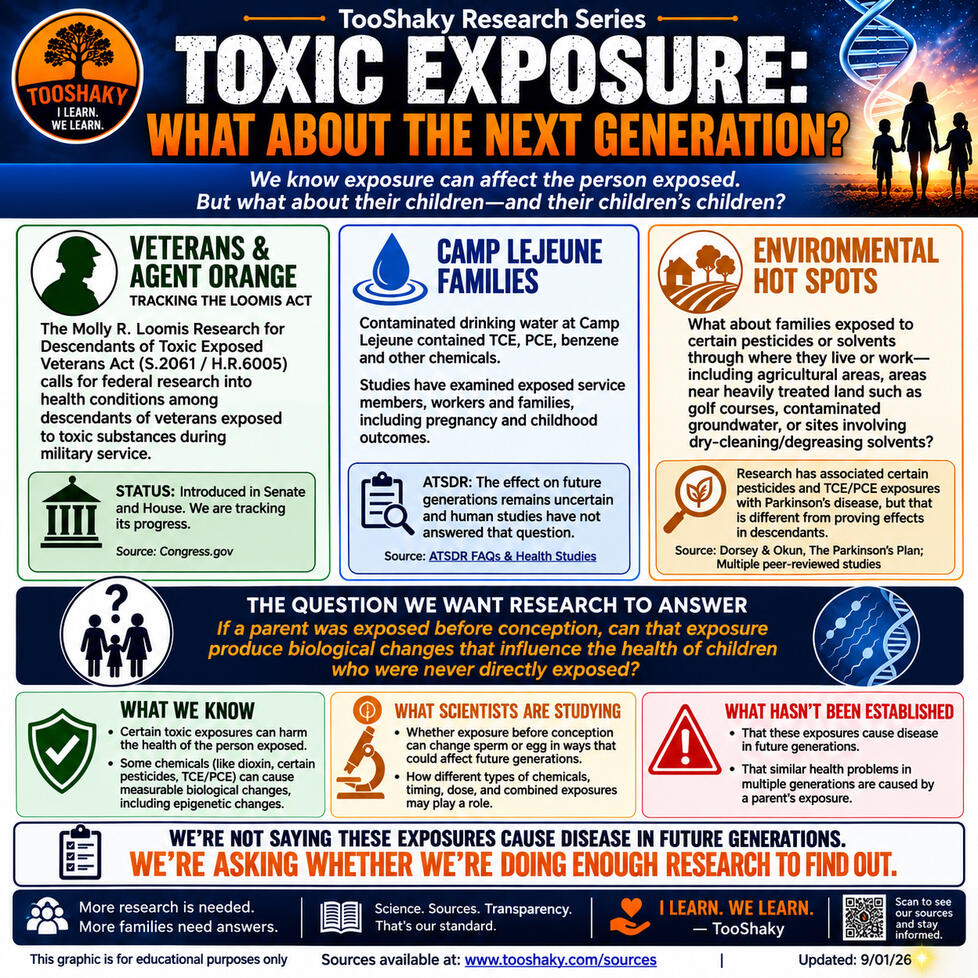
What happens when exposure to a toxic chemical affects more than the person who was exposed? Could the effects reach their children or even future generations?These are important questions scientists are working to answer.Environmental exposures, including Agent Orange, pesticides, and other potentially harmful chemicals, have raised concerns about long-term health effects and the possibility of effects across generations.Research involving animals has demonstrated that certain chemical exposures can produce biological changes that affect descendants. However, evidence establishing these effects across generations in humans remains limited, and more research is needed.
The Science, Simplified
Through this educational series, we explore what scientists have discovered, what remains unknown, and why continued research matters.The goal is not to convince anyone that a particular exposure caused their illness.
From Education to Advocacy
The goal is to understand what the scientific evidence tells us, and what questions still needs answers.
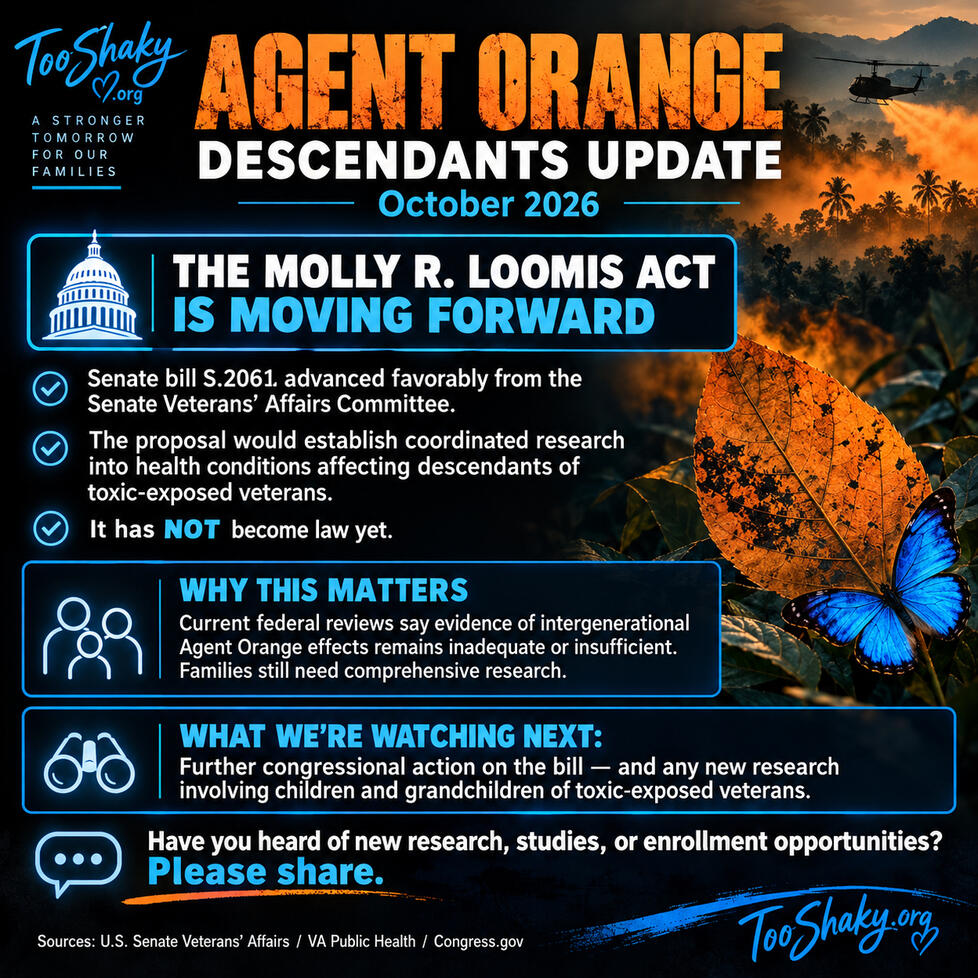
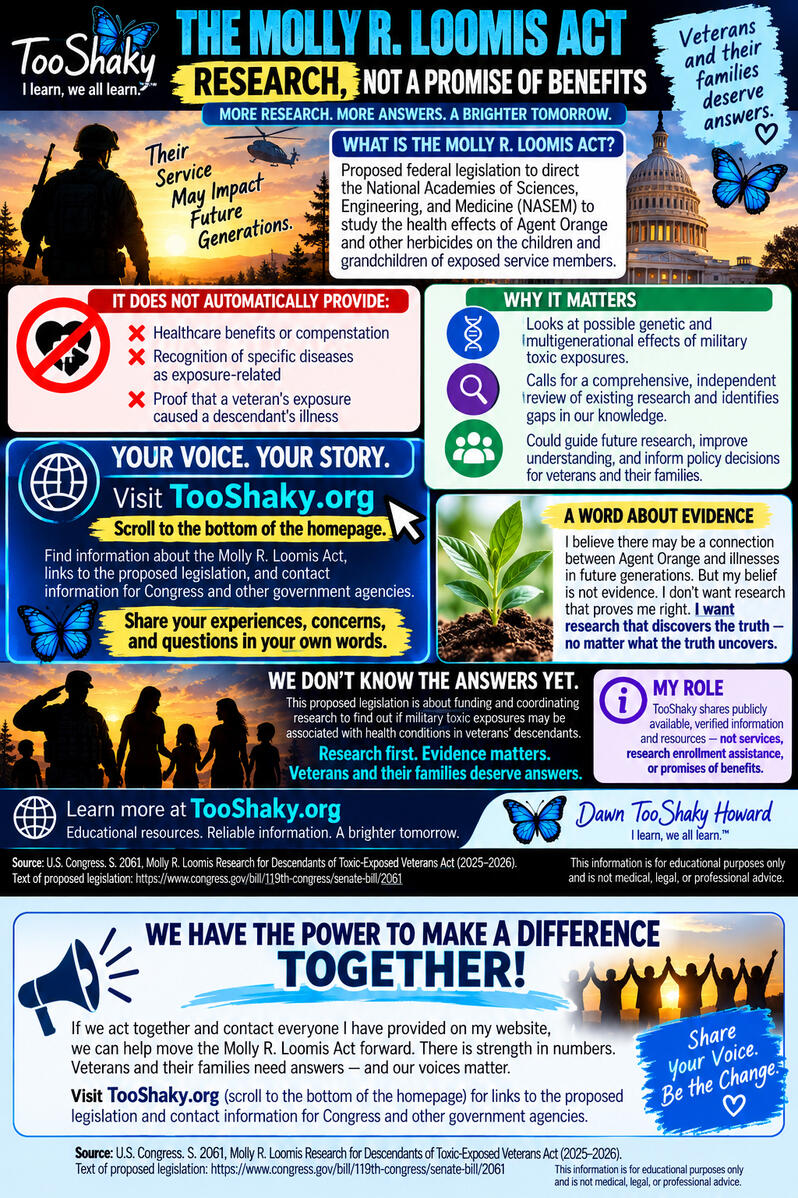
For families of veterans exposed to Agent Orange and other toxic substances, these questions are especially meaningful.The proposed Molly R. Loomis Research for Descendants of Toxic Exposed Veterans Act represents an effort to advance research into potential health effects among veterans' descendants.I invite you to explore the linked information about the legislation, learn why additional research is important, and find government contact information if you wish to be heard.I am not asking science to prove what I believe. I am asking science to discover the truth.We cannot change the past, but research will help us protect the future.
🔗 Explore More
The Science Simplified Series
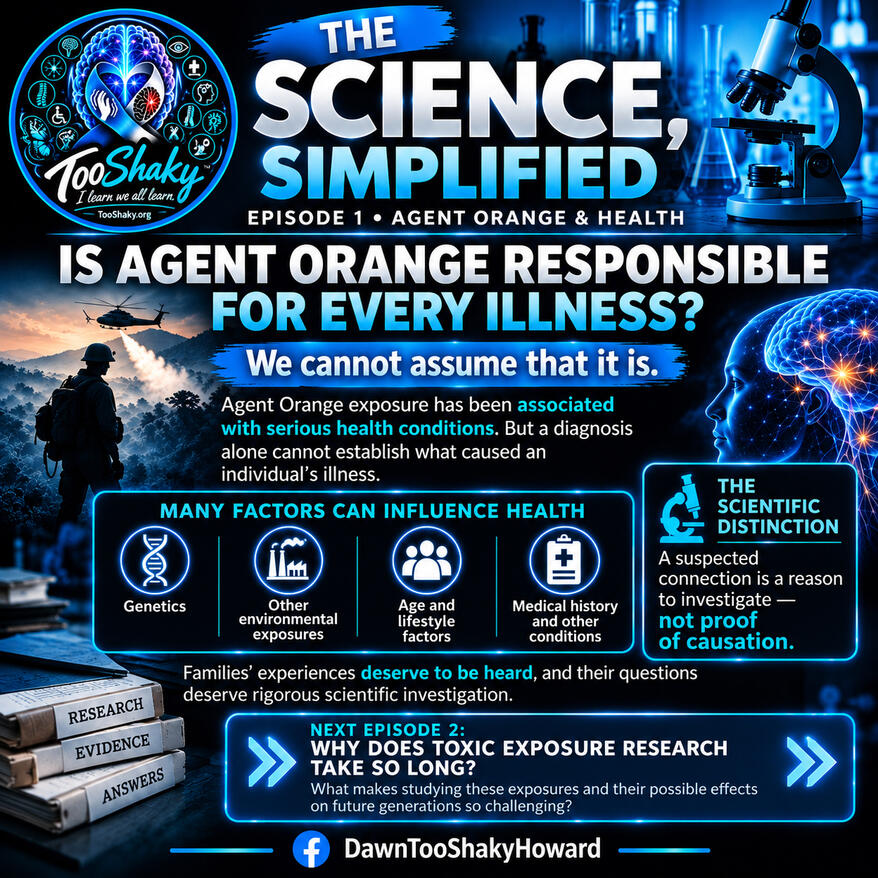
🔬 INTRODUCING: THE SCIENCE, SIMPLIFIED
Episode 1 | Agent Orange & Health
Could Agent Orange be the cause of the health issues we see in veterans and their families?
This is a question many families, including my own, have grappled with.
Exposure to Agent Orange has been linked to serious health conditions. But when multiple illnesses affect a family, pinpointing the exact cause can be challenging.
That’s why this series is so important.
In The Science, Simplified, TooShaky will break down what scientific research has confirmed, what is still under investigation, and what remains unknown about the effects of Agent Orange on future generations.
We’ll also examine ongoing studies, the significance of researching descendants, and legislative developments such as the Mary Loomis Act.
Our aim isn’t to make assumptions, but to ask questions, analyze evidence, and make complex science accessible to everyone.
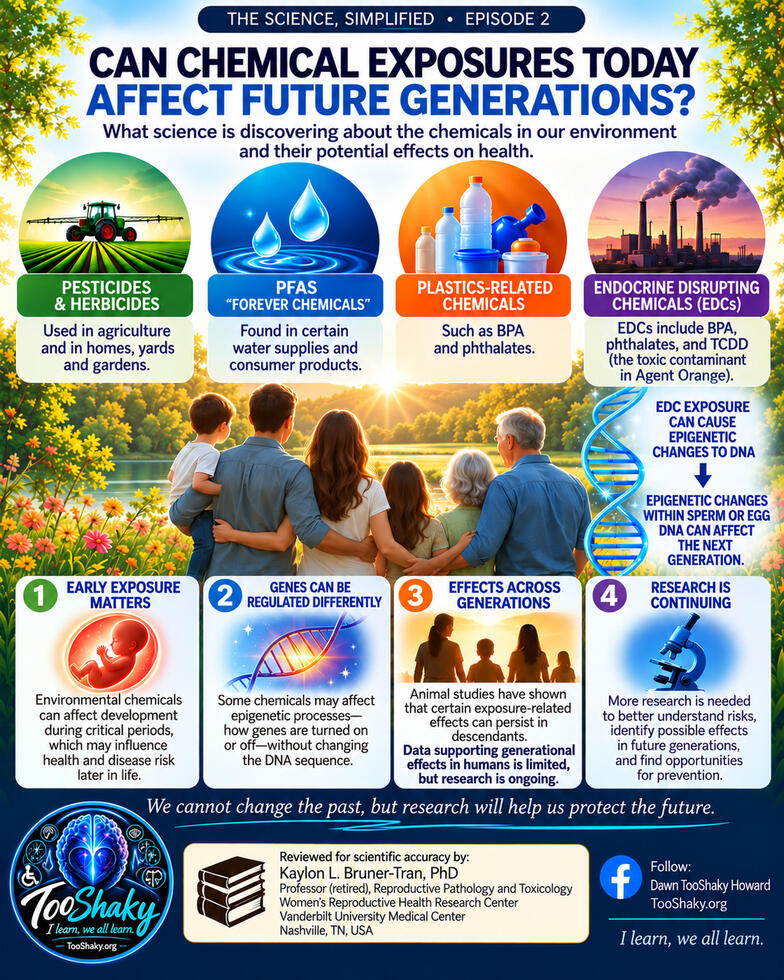
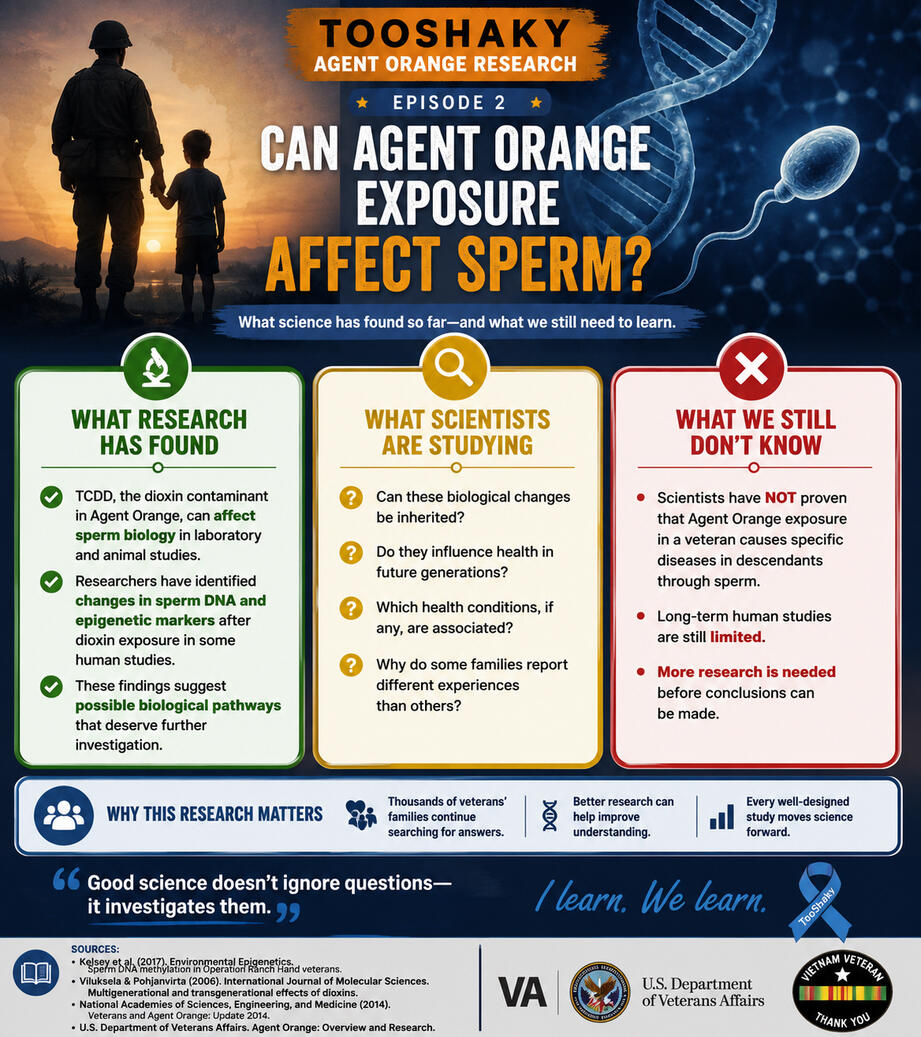
🔬 THE SCIENCE, SIMPLIFIED — EPISODE 2 Graphic ID: TSS-E02
🌎 CAN CHEMICAL EXPOSURES TODAY AFFECT FUTURE GENERATIONS?Last month, our discussions about toxic exposure generated more than 37,000 views. Many of the questions centered on one concern:
Could exposure to harmful chemicals affect not only the person exposed, but also their children, grandchildren, or future generations?
Today, we’re exploring what scientific research has discovered—and what remains unanswered.
Environmental chemicals are part of our everyday world. Pesticides, PFAS, plastics-related chemicals, and endocrine-disrupting chemicals have raised important questions about potential long-term health effects.
Research involving animals has demonstrated that certain chemical exposures can cause biological changes that affect descendants.
But here’s an important distinction: Evidence supporting these effects across generations in humans remains limited. Research is ongoing.
That’s why we need more scientific investigation—not assumptions.
❤️ A SPECIAL THANK-YOU
This episode was reviewed for scientific accuracy by Kaylon L. Bruner-Tran, PhD, retired professor of Reproductive Pathology and Toxicology at Vanderbilt University Medical Center.
Her expertise and willingness to help make complex scientific research understandable are deeply appreciated.
Our goal is not to prove that a particular chemical caused someone’s illness.
Our goal is to follow the evidence, understand what scientists have discovered, and recognize what we still don’t know.
Follow along as we continue exploring environmental exposures, scientific research, and the questions that matter to families today and in future generations.
We cannot change the past, but research will help us protect the future.
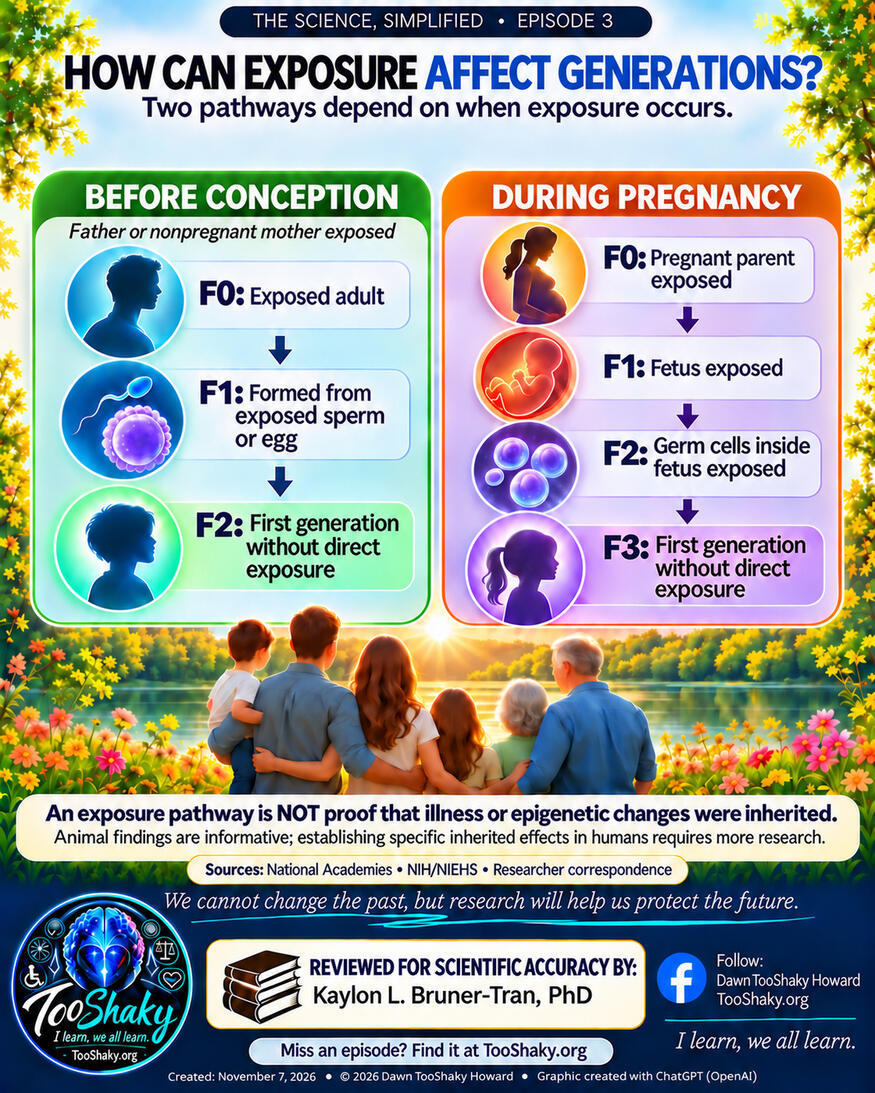
THE SCIENCE, SIMPLIFIED — EPISODE 3
How Can Exposure Affect Future Generations?
When someone is exposed to an environmental chemical, could the biological effects extend beyond that individual to their children or grandchildren?
Scientists investigate two important concepts: multigenerational and transgenerational effects.
The difference depends on both when exposure occurs and which generations or reproductive cells encounter the substance.
• Multigenerational effects result from direct exposure.
• Transgenerational effects occur in generations that were not directly exposed.
🔹 Before conception
When an adult (F0), sometimes called the founding generation, is exposed, their reproductive cells (sperm or eggs) are also exposed.
The child (F1) develops from those reproductive cells.
The grandchildren (F2) are the first generation without direct exposure to the original event.
🔹 During pregnancy
When a pregnant mother is exposed, three generations are exposed simultaneously:
• F0: The pregnant mother.
• F1: The developing baby.
• F2: The reproductive cells developing inside that baby.
The great-grandchildren (F3) are the first generation without direct exposure to the original event.
🧬 What about epigenetics?
Scientists have linked effects appearing in generations without direct exposure to epigenetic changes involving reproductive cells.
Epigenetic changes are different from genetic mutations.
Genetic mutations change the DNA sequence. Epigenetic changes can alter how genes function without changing that sequence.
🔬 What does research tell us?
Animal studies involving mice and rats have demonstrated that certain environmental chemical exposures can cause effects across generations, including generations that were not directly exposed.
Human research has identified multigenerational and transgenerational health effects associated with various exposures.
However, determining whether a particular chemical causes inherited epigenetic changes that lead to a specific disease in future generations remains challenging in human populations.
Exposure does not automatically mean that an illness will develop or be inherited.
Understanding these distinctions is important when investigating Agent Orange and other environmental exposures.
Our mission is to discover the truth through scientific research—not to prove assumptions.
💙 We cannot change the past, but research will help us protect the future.
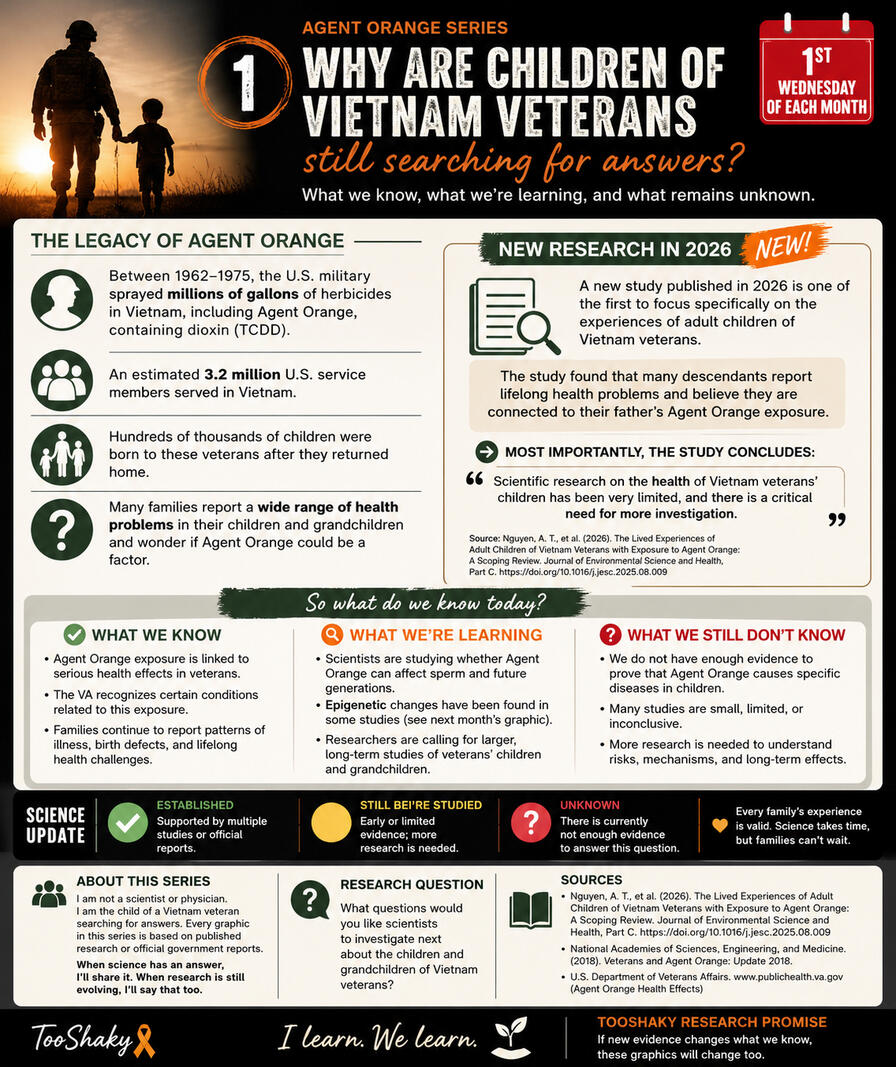
Agent Orange Research Series
© 2026 Dawn TooShaky Howard. All rights reserved.
Created and maintained by Dawn TooShaky Howard
Parkinson’s Advocate & Neurological Health Educator
Educational graphics created with assistance from ChatGPT (OpenAI).
Educational content is developed using information from reputable medical organizations, published scientific research, and other educational resources. Sources may include, but are not limited to, the Parkinson’s Foundation, The Michael J. Fox Foundation for Parkinson’s Research, American Parkinson Disease Association (APDA), Davis Phinney Foundation, Mayo Clinic, Cleveland Clinic, PubMed, PubMed Central (PMC), and peer-reviewed medical literature.
Disclaimer
This material is provided for informational and educational purposes only and is not intended to replace individualized medical advice, diagnosis, or treatment. Patients should discuss all medical questions and care decisions with their healthcare provider.
Sources are identified in the footers of applicable individual webpages. Additional references and complete source lists can be found by selecting the Sources button above.
TooShaky.org does not provide medical care and does not establish a clinician-patient relationship.